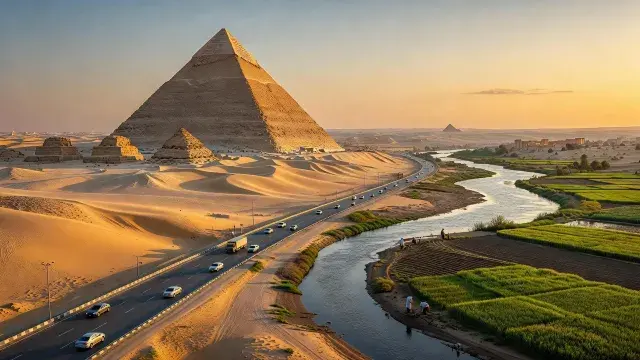
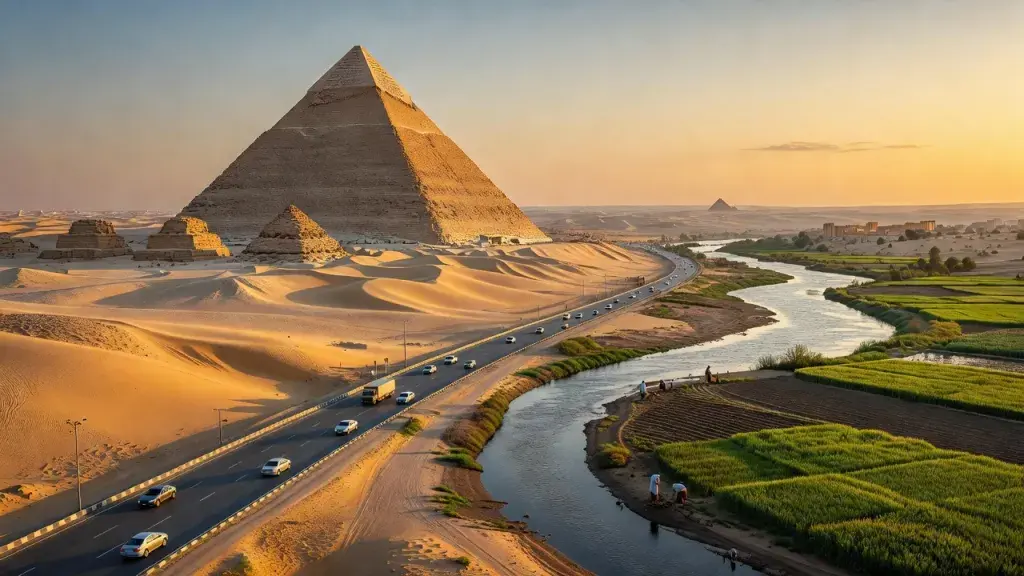
A pyramid built forty-five hundred years ago still stands within sight of a modern highway on the outskirts of Cairo. No mortar binds most of its stones together. No steel reinforces its core. Yet it has outlasted every empire that came after it, including the ones that tried to loot it, quarry it, or bury it in sand. That single fact says more about ancient egypt heritage than any museum placard could.
What makes this history worth revisiting is not nostalgia for a distant kingdom but the sheer reach of its fingerprints. The legacy of egypt culture shows up in places most people never think to look - in the geometry taught in a high school classroom, in the calendar hanging on a kitchen wall, in the way modern medicine still borrows terminology from Nile Valley physicians. For readers who enjoy exploring how ancient symbolism resurfaces in unexpected places, even entertainment has caught on: a themed slot title built around legacy of egypt features shows how these motifs continue to capture public imagination thousands of years after the fact. That kind of cultural persistence is rare, and it demands an explanation.
This piece traces that persistence from its origins along the Nile to its presence in contemporary life. It examines the civilization's political and religious foundations, the innovations that rippled outward into later societies, and the physical monuments that refuse to disappear. The aim is not to romanticize a lost world but to understand, concretely, why it never really left.
The Foundations of Ancient Egyptian Civilization
Egyptian civilization did not emerge in isolation. It grew from a specific set of geographic pressures - a narrow, fertile strip of land flanked by desert, dependent entirely on a river whose flooding cycle dictated the rhythm of daily existence. Understanding those pressures explains much of what followed, including the centralized authority and religious structures that defined the culture for three millennia.
Geography and the Nile's Role
The Nile's annual flood deposited nutrient-rich silt across the floodplain, turning an otherwise arid strip into some of the most productive farmland in the ancient world. This predictability allowed early Egyptians to plan agricultural cycles with unusual precision, freeing labor for construction, administration, and craft specialization. Without the river's discipline, the surplus economy that funded temples, tombs, and bureaucracies simply would not have existed.
Political Structure and the Role of the Pharaoh
The pharaoh occupied a position unlike most rulers in the ancient world - simultaneously head of state and living intermediary between gods and mortals. This dual authority consolidated power in a way that made large-scale projects, from irrigation systems to royal tombs, administratively possible. It also created a template for divine kingship that later cultures, from Nubia to parts of the Near East, adapted for their own purposes.
Religious Beliefs and Daily Life
Religion was not a separate sphere of Egyptian life; it was woven into agriculture, medicine, law, and death. Deities governed the flooding of the Nile, the judgment of souls, and the movement of the sun. This integration meant that religious institutions accumulated enormous wealth and influence, funding the priesthoods and construction projects that produced much of what survives today.
- Belief in an afterlife shaped burial customs and tomb architecture
- Temples functioned as economic centers, not just places of worship
- Local deities often merged with national gods as political unification progressed
Egyptian Civilization Impact on Science and Innovation
The practical demands of managing a river-based economy pushed Egyptian scholars toward genuine scientific advancement. Much of this knowledge traveled outward through trade, conquest, and later scholarly transmission, embedding itself in the intellectual traditions of Greece, Rome, and the Islamic world.
Mathematics and Engineering Achievements
Egyptian mathematicians developed practical geometry to resurvey farmland after each flood erased boundary markers. That same geometric knowledge underpinned the construction of pyramids with remarkably precise alignments to cardinal directions - a feat that still puzzles engineers who attempt to replicate the accuracy without modern instruments.
Medicine and the Human Body
Egyptian physicians documented surgical procedures, splinting techniques, and pharmacological remedies on papyrus scrolls centuries before Hippocrates. Some of their anatomical observations, particularly regarding the circulatory system, anticipated ideas that would not be formally confirmed until much later in medical history.
Writing Systems and Record-Keeping
Hieroglyphic writing served administrative, religious, and literary functions simultaneously. The Egyptian scribal tradition established record-keeping practices that influenced later Mediterranean bureaucracies, demonstrating just how far egyptian history influence extended beyond its own borders.
The Legacy of Egyptian Culture in Art, Religion, and Philosophy
Beyond engineering and science, Egyptian civilization exported ideas about beauty, mortality, and cosmic order that shaped artistic and philosophical traditions well outside its own territory.
Artistic Conventions and Symbolism
Egyptian art followed strict conventions - figures in composite profile, standardized proportions, symbolic use of color - that prioritized permanence and order over naturalistic variation. This visual language influenced neighboring cultures and later found renewed appreciation during periods of European fascination with the ancient Nile.
Concepts of the Afterlife and Their Influence
The Egyptian belief in judgment after death, weighed against moral conduct, resembles concepts that appear in later religious traditions across the Mediterranean and Near East. Scholars continue to debate the extent of direct transmission, but the parallels are difficult to dismiss as coincidence.
Mythology's Reach Beyond Egypt
Deities such as Isis found worshippers as far away as Roman Britain, carried by soldiers, traders, and travelers who adopted Egyptian religious practices alongside their own. This kind of cultural diffusion illustrates how thoroughly the legacy of egypt culture penetrated foreign belief systems.
Enduring Egypt Monuments That Still Define the Civilization
Physical structures remain the most immediate evidence of Egyptian achievement. Their survival across millennia, despite erosion, looting, and political upheaval, speaks to construction techniques that modern engineers still study closely.
The Pyramids of Giza
The Great Pyramid, built as a tomb for Pharaoh Khufu, required a labor force organized with a level of logistical sophistication rarely appreciated outside academic circles. Recent archaeological work on nearby worker settlements has dismantled the old myth of slave labor, revealing instead a paid, rotating workforce housed and fed by the state.
The Temples of Karnak and Luxor
These temple complexes expanded over centuries, with successive pharaohs adding halls, obelisks, and statuary to demonstrate their piety and legitimacy. Walking through Karnak's hypostyle hall today, visitors encounter columns so massive that the scale itself communicates the power once concentrated in Egyptian religious institutions.
The Valley of the Kings and Royal Tombs
Carved into limestone cliffs across the Nile from Thebes, these tombs reveal how deeply Egyptian elites invested in the afterlife. Tutankhamun's tomb, discovered largely intact in 1922, offered an unprecedented window into royal burial practices and remains one of the most cited archaeological finds of the twentieth century.
Egyptian History Influence on Modern Culture and Identity
Egypt's ancient past did not stay confined to academic study. It has shaped tourism economies, national identity, and popular culture in ways that continue to evolve.
Egyptomania in Art and Popular Media
Napoleon's Egyptian campaign in the late eighteenth century triggered a wave of European fascination that produced everything from architectural motifs to decorative arts. That fascination never fully faded, resurfacing periodically in film, fashion, and design whenever a major discovery reignites public interest.
Modern Egyptian National Identity
Contemporary Egypt draws heavily on its pharaonic past as a source of national pride and tourism revenue. Government initiatives to restore and showcase ancient sites reflect an understanding that this heritage functions as both cultural anchor and economic asset.
Preservation Challenges and Ongoing Discoveries
Urban expansion, water table changes, and mass tourism all threaten fragile ancient structures. Despite these pressures, new discoveries continue at a steady pace, including recently uncovered tombs and settlements that keep reshaping scholarly understanding of daily life along the ancient Nile.
Why Ancient Egypt Heritage Still Matters Today
Studying this civilization offers more than historical curiosity. It provides a working example of how a society organized around scarcity, religion, and centralized authority produced achievements that outlasted the political systems that built them.
Lessons in Long-Term Planning and Resource Management
Egyptian irrigation and grain storage systems demonstrate early, sophisticated approaches to resource management under environmental constraint - a subject with obvious relevance to modern discussions about sustainability and infrastructure planning.
Cultural Continuity Across Millennia
Few civilizations maintained artistic, religious, and administrative continuity across three thousand years the way Egypt did. That continuity offers researchers a rare long-term dataset for studying how cultures adapt, or resist adapting, to changing political circumstances.
Frequently Asked Questions
Why did the pyramids survive so much longer than most ancient structures?
Their massive stone construction, precise engineering, and relatively stable desert climate all reduced the erosion and weather damage that destroyed comparable structures built from mudbrick or wood elsewhere in the ancient world.
How did Egyptian religion influence later belief systems?
Concepts such as judgment after death and the worship of deities tied to natural cycles spread through trade and conquest, influencing religious ideas in Greece, Rome, and parts of the Near East, though direct lines of influence remain a subject of ongoing scholarly debate.
What made Egyptian mathematics and engineering so advanced for their time?
Practical necessity drove much of it - annual flooding required precise land resurveying, which pushed Egyptian scholars toward applied geometry that later supported architectural feats like the pyramids' near-perfect cardinal alignment.
Are new discoveries still being made in Egypt today?
Yes. Archaeological teams continue to uncover tombs, settlements, and artifacts, often using ground-penetrating radar and other non-invasive techniques that reveal structures without disturbing fragile sites.
Why does ancient Egyptian imagery still appear so often in modern entertainment and design?
The visual language of Egyptian art-symmetry, gold, monumental scale, and mythological symbolism-translates easily into striking modern visuals, which is why it recurs so consistently across film, fashion, and even themed entertainment products.
What threats do Egyptian monuments face in the modern era?
Rising groundwater levels, urban development, pollution, and heavy tourist traffic all place mechanical and chemical stress on structures that were never designed to withstand modern environmental conditions.