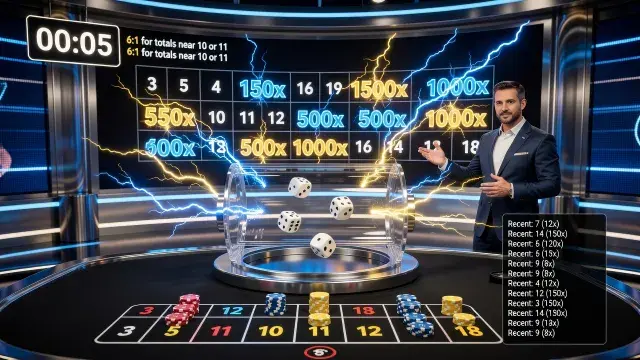
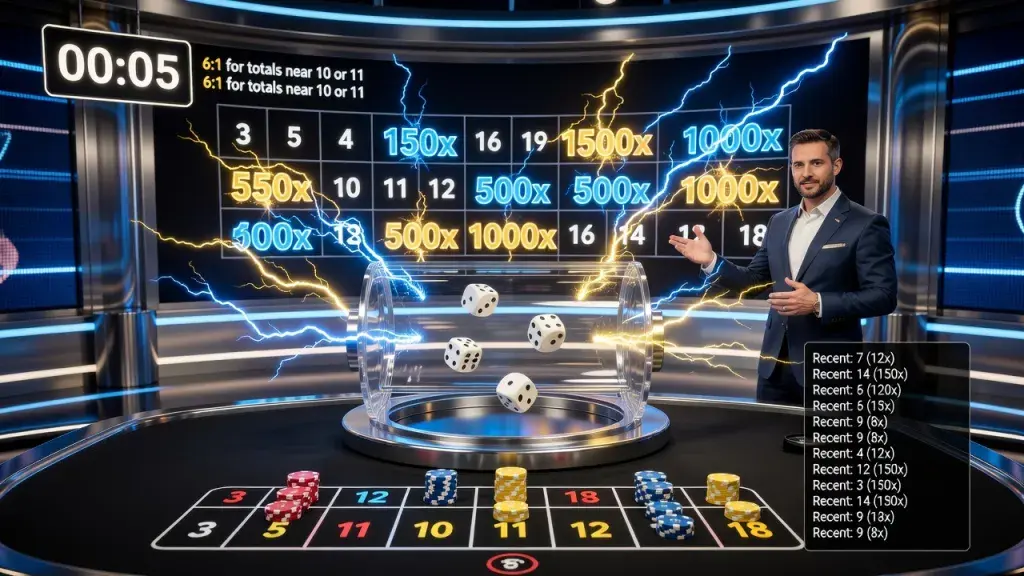
Three dice, one lightning-charged wheel, and multipliers that can spike a single number to 1000x its base payout - that's the entire premise, and yet the game holds attention far longer than its simplicity suggests. Dice games have a reputation for being blunt instruments: roll, win or lose, repeat. Lightning Dice breaks that pattern by injecting a randomized multiplier mechanic borrowed from electrified live casino formats, turning a straightforward numbers game into something with genuine tension on every spin.
What makes this worth examining closely is how the math actually behaves once the lightning strikes start landing on specific totals. Before betting real money, most players benefit from checking a detailed lightning dice review that breaks down payout tables and session data across multiple platforms, since presentation and betting limits can vary between operators even when the core RNG or live mechanic stays the same. That distinction matters more than casual players assume, because a game that looks identical on the surface can pay out quite differently depending on where you play it.
This piece walks through how the game functions round by round, which betting patterns hold up under scrutiny, what the real odds look like once the multiplier variance is factored in, and which habits separate players who leave sessions ahead from those who don't.
Lightning Dice Game Review: First Impressions and Core Mechanics
The format sits somewhere between a live game show and a traditional casino table. A host or automated system rolls three six-sided dice inside a transparent drum, and players bet on the sum of those three dice before the roll happens. Totals range from 3 to 18, and each number carries its own fixed payout based on statistical probability - lower and higher totals pay more because they occur less frequently, while totals clustered near 10 or 11 pay less because three dice naturally gravitate toward the middle of the range.
The twist arrives before the roll, when a randomized number of "lightning numbers" get struck by an animated bolt, each receiving a temporary multiplier that can range from a modest boost to several hundred times the standard payout. If the dice land on a struck number, every bet placed on that total gets multiplied accordingly. This single mechanic transforms a fairly flat probability game into one where anticipation builds noticeably in the seconds before the roll.
How a Typical Round Unfolds
A round starts with a betting window, usually lasting between ten and twenty seconds depending on the platform. Players select one or more totals from the 3-18 range and confirm their stake. Once betting closes, the lightning strikes assign multipliers to a random subset of numbers - typically between two and five numbers per round. The dice then roll, and the result determines payouts instantly.
The Role of Random Number Generation
Even in live-hosted versions, the physical dice roll is monitored by verification software, and the lightning multiplier assignment runs on a certified random number generator. This matters for trust: the multiplier placement is not influenced by betting patterns or previous rounds, which keeps the game mathematically independent round to round.
- Betting window: fixed duration, no late bets accepted
- Lightning strikes: random numbers receive multipliers before the roll
- Dice roll: three dice, sum determines the winning total
- Payout: instant, based on base odds multiplied by any lightning bonus
Lightning Dice Gameplay: Step-by-Step Breakdown
Understanding lightning dice gameplay in sequence removes most of the confusion new players report during their first few sessions. The interface typically displays a betting grid numbered 3 through 18, a live or animated dice drum, a countdown timer, and a running history of recent results. Betting limits are usually flexible enough for both cautious and aggressive players, ranging from small minimum stakes to substantial maximums depending on the table.
Placing Bets and Reading the Grid
Each number on the grid shows its base payout multiplier next to it. Totals like 3 or 18 might show payouts near 150:1, while 10 or 11 might show something closer to 6:1. Players can spread stakes across multiple numbers in a single round, which changes the risk profile substantially compared to betting everything on one total.
Interpreting Lightning Multipliers in Real Time
Once the lightning effect lands, the interface updates payout values on the struck numbers instantly. A number that normally pays 8:1 might suddenly show 500:1 for that single round only. This is the moment that generates the most visible excitement at live tables, and it's also where impulsive betting tends to spike - a behavior worth resisting rather than encouraging.
Reading Results and History Panels
Most platforms display the last twenty to fifty rounds in a visible history strip. While each roll is independent, many players use this history to track how frequently certain totals or multiplier zones have appeared recently, mostly as a way of pacing their own betting rather than predicting future outcomes.
Lightning Dice Strategy: What Actually Works
No betting pattern changes the underlying probability of any given roll, but that doesn't mean strategy is irrelevant. Bankroll allocation, bet spread, and session pacing all influence how long a player's funds last and how effectively they capture multiplier windows when they appear.
Spread Betting Versus Concentrated Betting
Spreading smaller stakes across five or six totals near the middle of the distribution (8 through 13) increases the frequency of small wins, since these totals occur more often statistically. Concentrated betting on extreme totals like 4 or 17 offers rare but substantial payouts, especially valuable when lightning strikes happen to land there. Neither approach is objectively superior - they simply serve different risk tolerances.
Bankroll Management Across Sessions
Setting a fixed loss limit and a target win threshold before starting a session prevents the emotional escalation that dice games can provoke once a lightning multiplier is narrowly missed. Dividing a total bankroll into smaller session units, rather than risking it all in one sitting, extends playtime and gives more rounds a chance to include favorable multipliers.
Adjusting Strategy Based on Multiplier Frequency
Some sessions produce lightning strikes concentrated on high-value edge totals; others cluster multipliers near the middle. Adapting bet placement round to round based on where multipliers have recently landed won't guarantee results, but it does align stakes with the pattern currently in play rather than ignoring it entirely.
- Set a session bankroll and stick to it strictly
- Balance high-payout edge bets with steadier mid-range bets
- Avoid chasing losses after a near-miss multiplier round
- Review recent multiplier placement before adjusting bet size
Lightning Dice Odds: The Real Numbers Behind the Game
Because three dice are rolled together, the probability distribution across totals 3 through 18 follows a bell curve rather than a flat distribution. Totals like 10 and 11 occur far more often than 3 or 18, which is exactly why base payouts are structured inversely to frequency. This is standard probability theory applied to gambling design, and it's the same logic behind payout tables in games like Sic Bo.
Base Payout Structure Without Multipliers
Extreme totals (3 and 18) pay the highest base rate because only one dice combination produces them. Totals closer to the center pay less because dozens of combinations can produce that same sum. This structure keeps the house edge relatively consistent across the entire betting grid before any lightning effect is applied.
How Lightning Multipliers Shift the House Edge
The lightning mechanic adds variance without meaningfully changing the long-term house edge, since multiplier placement is random and applies equally across all players. In the short term, however, hitting a struck number can produce payouts far beyond what standard dice odds alone would ever offer - this is the appeal, not a change in the underlying math.
Comparing Lightning Dice Odds to Other Dice Games
Compared to standard craps or Sic Bo, lightning dice odds are broadly similar in structure but offer higher ceiling payouts thanks to the multiplier feature. Players accustomed to flat-payout dice games often find the added volatility either thrilling or unsettling, depending on their risk appetite.
Lightning Dice Winning Tips for Consistent Play
Winning tips for this game center less on prediction and more on discipline, timing, and realistic expectations. No system beats the randomness of the roll, but disciplined habits noticeably improve the player experience and reduce unnecessary losses.
Timing Your Bets Around Multiplier Patterns
Waiting to observe a few rounds before committing larger stakes can help players gauge current multiplier tendencies without any cost beyond patience. This isn't prediction - it's pacing.
Avoiding Common Beginner Mistakes
New players frequently overbet on middle totals purely because they see them win often, ignoring that the payout per win is proportionally lower. Others chase a single elusive high-payout number for many rounds in a row, draining their bankroll before it ever gets struck by lightning.
Knowing When to Walk Away
Setting both a win goal and a stop-loss point before starting, and honoring both without exception, remains the single most reliable habit separating long-term players from those who burn through funds in a single unlucky session.
Frequently Asked Questions
Is lightning dice purely luck, or does skill play any role?
The dice roll itself is entirely luck-based and cannot be influenced. Skill enters through bankroll management, bet distribution, and knowing when to stop, which affects how well a player capitalizes on favorable multiplier rounds over time.
How often do lightning multipliers actually appear on high-value numbers?
Multiplier placement is randomized each round and isn't fixed to favor any particular total. Over many sessions, multipliers land across the full range of numbers roughly evenly, though any single session can feel streaky in either direction.
What's the safest betting approach for a beginner?
Spreading small, equal stakes across four or five mid-range totals limits variance while still allowing beginners to experience wins frequently enough to understand the payout structure before risking larger amounts on edge totals.
Can betting patterns from previous rounds predict the next roll?
No. Each roll and each multiplier assignment is generated independently, verified by random number generation standards, and carries no memory of prior results regardless of how the recent history panel looks.
Why do totals like 3 and 18 pay so much more than 10 or 11?
Only one combination of three dice produces a 3 or an 18, while many combinations produce totals near the middle of the range. Payouts are set inversely to frequency so the game maintains a consistent house edge across the entire betting grid.
Is it better to bet on one number or spread bets across several?
Spreading bets produces more frequent, smaller wins and smoother bankroll movement, while concentrating on one or two extreme numbers offers rare but much larger payouts. The right choice depends entirely on individual risk tolerance rather than any mathematical advantage.