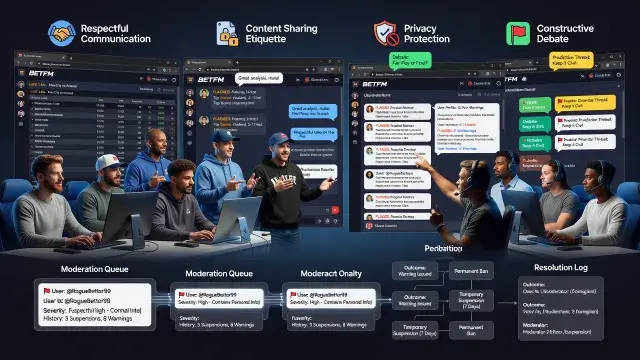
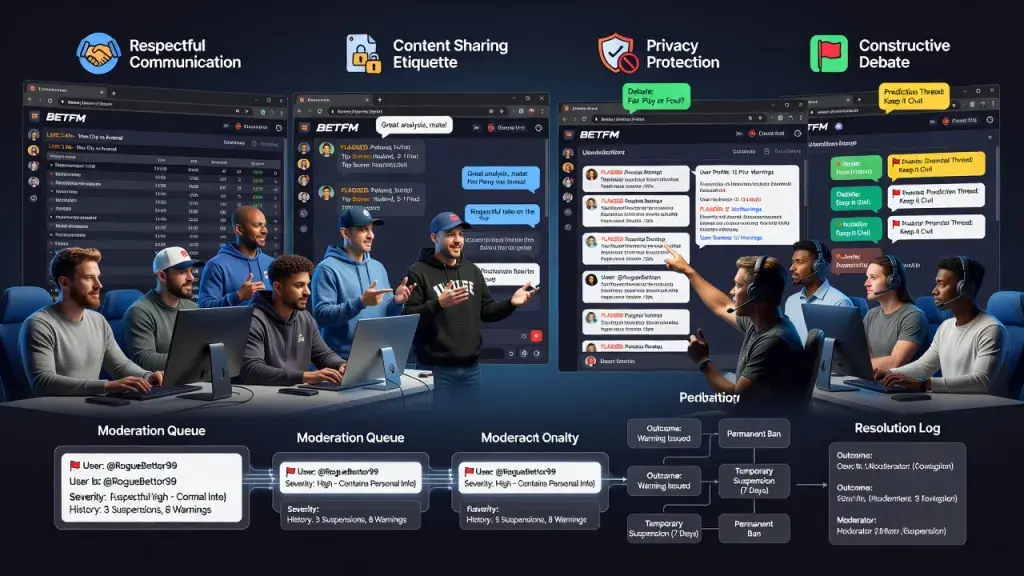
A single flagged comment can trigger a review process involving multiple layers of verification before any account restriction is applied. That level of procedural care surprises many users who assume moderation decisions happen instantly and arbitrarily. On platforms where money, competition, and public interaction intersect, the mechanics of enforcement matter as much as the rules themselves.
Betting communities attract a wide range of personalities - analytical bettors, casual fans, and occasionally people looking to exploit weak moderation. That mix is precisely why a structured framework exists. The betfm user conduct policy was built to keep discussions fair, transactions honest, and interactions free from harassment or manipulation. For readers who want the original source material rather than a summary, the platform publishes its full requirements at betfm user conduct rules, which lays out the baseline expectations for every member.
What follows is a breakdown of how that policy actually functions: what it covers, what it prohibits, how violations are reported, and what happens once a complaint lands in front of a moderator. Understanding this system is not just a compliance exercise - it directly affects how safely and confidently someone can participate in the community.
Understanding the BETFM User Conduct Policy
The betfm user conduct policy functions as the foundational document governing how members interact across forums, chat features, betting discussions, and any shared community space. It exists to answer one core question: what does responsible participation look like on a platform where financial stakes and public opinion mix?
Purpose and Scope of the Policy
The policy applies to every registered user, regardless of account tier or activity level. It covers written communication, shared content, direct messaging where available, and any behavior that affects other members' experience. The scope is intentionally broad - narrow policies tend to leave gaps that bad actors exploit.
Who the Policy Protects
Three groups benefit directly: individual users seeking a harassment-free environment, the platform itself in terms of legal and reputational exposure, and the broader community whose trust depends on consistent enforcement. A policy that only protects the company, without addressing user safety, rarely survives long-term scrutiny from its own user base.
How the Policy Differs From General Terms of Service
Terms of Service typically address account creation, payment processing, and liability. The conduct policy narrows in specifically on behavior - what people say, how they interact, and what actions cross a line. This separation allows the platform to update behavioral standards without renegotiating the entire legal agreement with users.
Core BETFM Community Guidelines
The betfm community guidelines translate the conduct policy into practical, everyday rules. Where the policy sets legal boundaries, the guidelines describe tone, etiquette, and the spirit of acceptable interaction.
Respectful Communication Standards
Disagreement over odds, predictions, or strategy is expected and healthy. Personal attacks, discriminatory language, or targeted insults are not. The guidelines draw a clear line between critiquing an argument and attacking the person making it.
Content Sharing and Discussion Etiquette
Members are encouraged to share analysis, insights, and betting perspectives, but guidelines restrict spam, repetitive self-promotion, and misleading tips presented as guaranteed outcomes. Community trust erodes quickly when unverified claims circulate as fact.
Privacy and Data Respect Among Users
Sharing another user's personal details, screenshots of private conversations, or identifying information without consent violates the guidelines regardless of intent. This rule protects users from doxxing and unwanted exposure in a space where financial activity is already sensitive.
Acceptable User Behavior Rules in Practice
Written rules only matter if users understand how they apply to real situations. The acceptable user behavior rules translate abstract principles into concrete examples that clarify gray areas.
Examples of Acceptable Conduct
- Constructive debate about odds, strategies, or match outcomes
- Reporting suspicious activity through official channels rather than public callouts
- Sharing personal betting experiences without pressuring others to follow specific advice
- Using accurate, non-misleading information when discussing statistics or results
Examples of Behavior That Crosses the Line
- Coordinated harassment campaigns against specific users
- Impersonating staff members or claiming false affiliation with the platform
- Manipulating discussion threads to promote fraudulent betting schemes
- Repeated evasion of previous bans through new accounts
Gray Areas and Contextual Judgment
Not every rule application is black and white. Sarcasm, cultural differences in communication style, and heated sports rivalries can blur intent. Moderators are trained to weigh context - a single sharp comment during a tense match discussion is treated differently than a sustained pattern of hostility.
Reporting and Handling User Misconduct
An effective policy is only as strong as its enforcement mechanism. Reporting and handling user misconduct requires a process that is accessible to users, transparent enough to build trust, and rigorous enough to prevent abuse of the reporting system itself.
How to Submit a Misconduct Report
Most platforms, including betfm, provide in-context reporting tools attached directly to posts, messages, or user profiles. Reports typically require a brief description of the issue and, where possible, supporting evidence such as screenshots or message timestamps. Vague or unsubstantiated reports slow down review and reduce the likelihood of swift action.
What Happens After a Report Is Filed
Once submitted, a report enters a review queue where moderators assess severity, check user history, and determine whether the behavior violates specific clauses within the conduct policy. Straightforward violations - spam, explicit harassment - often move faster than ambiguous cases requiring additional context or witness statements.
Timeframes and Communication During Review
Response times vary based on report volume and complexity. Simple cases may resolve within a day or two, while cases involving appeals or conflicting accounts take longer. Users who filed the report typically receive a notification once a decision is reached, though specific disciplinary details about the other party are often kept confidential.
User Violation Terms and Enforcement
Rules without consequences invite abuse. The user violation terms and enforcement structure defines what penalties apply, how severity is measured, and what recourse exists for users who believe a decision was unfair.
Categories of Violations
Violations generally fall into tiers: minor infractions such as off-topic spam, moderate violations like repeated rule-breaking after warnings, and severe violations including fraud, harassment, or coordinated manipulation. Each tier carries proportionate consequences rather than a one-size-fits-all penalty.
Penalty Structures: Warnings, Suspensions, and Bans
First-time minor offenses often result in a warning or temporary content removal. Repeated or moderate violations can lead to timed suspensions, restricting account access for a set period. Severe or repeated severe violations typically result in permanent bans, particularly when fraud or safety risks are involved.
Appeals and Dispute Resolution
Users who believe enforcement was applied incorrectly generally have the right to appeal through a formal review request. This process usually involves a secondary moderator or review team examining the original decision independently, reducing the risk of a single reviewer's bias determining a final outcome.
Why Enforcement Consistency Matters for the Community
A conduct policy loses credibility the moment enforcement feels arbitrary. Consistency is not a nicety - it is the mechanism that keeps users trusting the system enough to report problems instead of ignoring them or retaliating directly.
Building Trust Through Transparent Enforcement
When users see that similar violations receive similar consequences regardless of account status or activity level, they are more likely to respect the guidelines rather than test their limits. Transparency does not mean publicizing every disciplinary detail, but it does mean clear communication about what rules exist and why they matter.
The Cost of Inconsistent Moderation
Selective enforcement - punishing some users harshly while letting others slide - breeds resentment and encourages workaround behavior. Communities that tolerate this inconsistency often see an increase in reported grievances and a decline in genuine engagement, as users disengage rather than risk uneven treatment.
Frequently Asked Questions
Can I report a user anonymously?
Most reporting tools allow you to submit a complaint without the other user seeing your identity directly. The platform's moderation team still knows who filed the report internally, since that information is often needed for follow-up questions or evidence verification.
What happens if my report is found to be false or exaggerated?
Repeated false reporting can itself be treated as a form of misconduct, since it wastes moderation resources and can unfairly damage another user's standing. A single mistaken report made in good faith is unlikely to result in penalties against the reporter.
How long does a temporary suspension usually last?
Duration depends on the severity and history of the violation. First suspensions tend to be shorter, often lasting days rather than weeks, while repeated offenses after a prior suspension typically result in longer restriction periods or permanent removal.
Will I be told exactly what disciplinary action was taken against someone I reported?
Generally, no. Platforms tend to keep specific disciplinary outcomes private to protect user privacy, even when the report was valid and action was taken. You will usually receive confirmation that the report was reviewed and addressed, without full detail on the exact penalty.
Can old violations affect future enforcement decisions?
Yes. Moderation teams typically review account history when deciding on penalties, meaning a pattern of past violations can result in harsher consequences for a new infraction, even a minor one.
Is there a way to prevent misunderstandings from escalating into formal violations?
Clarifying intent early, avoiding heated exchanges in public threads, and using private messaging for direct disputes can prevent minor disagreements from being reported. Reading the community guidelines before engaging in contentious topics also reduces the risk of unintentional rule-breaking.